


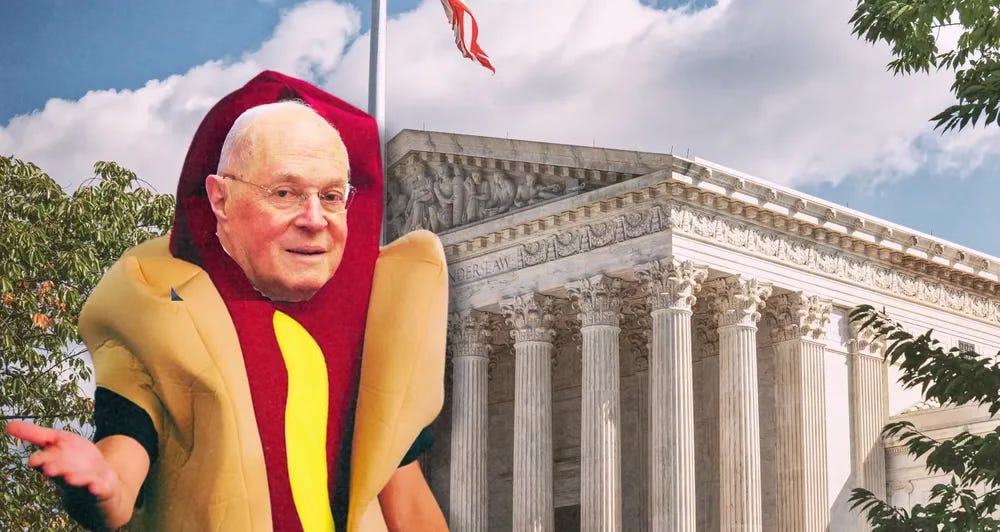
Former longtime Supreme Court Justice Anthony Kennedy was recently on a legacy-redemption book tour doing his best impression of the hot dog guy trying to find the guy who did this. But if you listened to The Lever’s award-winning first season of Master Plan (or read the book), you know that as the author of the Citizens United decision, Kennedy is among the most powerful architects of this dystopian age.
But that’s not just because of his campaign finance crusade that created the conditions for oligarchy and endemic corruption. It’s also because Kennedy abruptly reversed himself to cast the deciding vote to help the fossil fuel industry incinerate clean energy policy amid the climate emergency.
Recall that in 2007, Kennedy cast the deciding vote in the landmark Massachusetts v. EPA case that affirmed the executive branch’s power to regulate greenhouse gases as pollutants.
Fast forward nine years and the Supreme Court in 2016 issued a one paragraph order in West Virginia v EPA declaring that the executive branch does not have the power to regulate greenhouse gases.
The New York Times reports today on secret memos showing how that order was championed by Chief Justice John Roberts — a hard-edged and imperious ideologue long misportrayed as a thoughtful moderate. One of Roberts’ key accomplices in this tale was Kennedy. Despite having voted to uphold Massachusetts v EPA, the Times reports that Kennedy was the pivotal vote in the scheme to not only stop the Obama administration’s Clean Power Plan, but to take the unprecedented step of stopping it in expedited fashion through the controversial shadow docket that prevents oral arguments, fact-finding and judicial guidance:
The decision would come down to Justice Kennedy.
On Feb. 9, he dashed off a quick, three-sentence note. He believed that the Supreme Court would ultimately stay the Clean Power Plan soon anyway, and that there was no reason to put off the inevitable. He was voting with the chief justice.
Over just five days, the justices had decided the issue. Even as they debated the Obama plan’s possible burden on the power industry, in the entire chain of correspondence obtained by The Times, not a single justice, conservative or liberal, mentioned the dangers of a warming planet as one of the possible harms the court should consider.
The Massachusetts and West Virginia cases were certainly different. In the former, plaintiffs were trying to force the executive branch to use climate policy power its Environmental Protection Agency refused to wield or acknowledge it had. In the latter, plaintiffs were trying to block the executive branch from using the climate policy power they were actually trying to wield. But the central issue was similar — whether the executive branch actually had the power to regulate greenhouse gases in the first place.
So it is worth noting how Kennedy’s switch tracks with party control of the White House. Kennedy voted in support of executive branch authority when Republican George W. Bush was president, and then voted to crush that authority when Democrat Barack Obama was president.
Does that mean Kennedy was less a thoughtful “persuadable person,” as the Times casts him as, and more just a partisan hack? It’s a good question. After all, you might suspect that Kennedy was comfortable affirming regulatory authority for a Republican-led Environmental Protection Agency that might not aggressively use it to mess with the fossil fuel industry. You might also suspect that Kennedy didn’t want to affirm similar authority if it might be wielded by a Democrat.
Are such suspicions of partisanship legit? Well, consider some data:
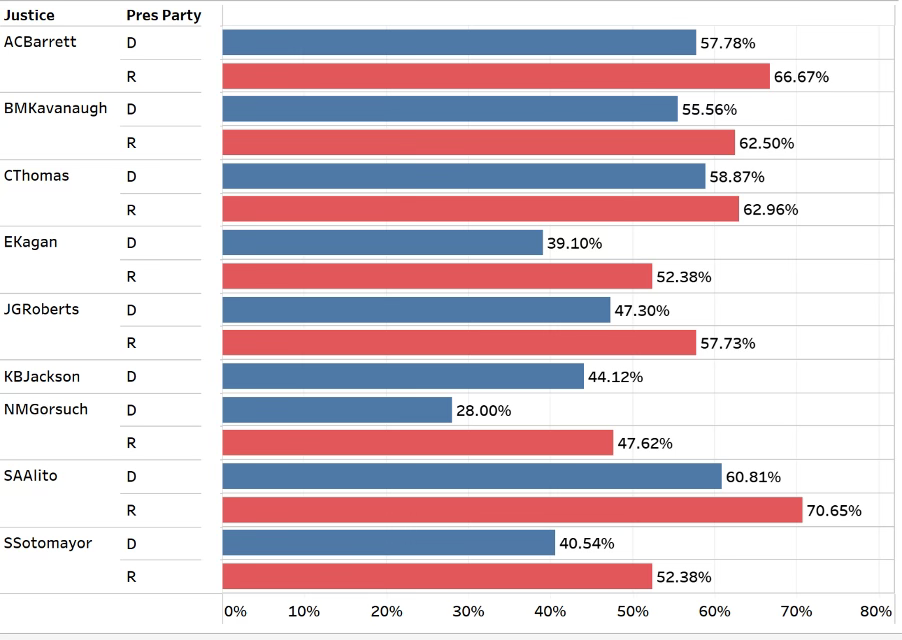
This is a graph from Legalytics’ Adam Feldman, which shows how often Supreme Court justices vote with the United States — read: the executive branch — in cases about presidential power. The graph shows how those votes break down when different parties control the White House. Feldman’s analysis shows that every justice on the Roberts court is more likely to side with the United States when a Republican is president.1
How much of this trend is purely partisan (Democrat/Republican) or ideological (liberal/conservative) is difficult to say, considering that Democratic appointees are part of the trend.2
But what’s clear once again is that the Supreme Court is not some dispassionate, apolitical umpire calling “balls and strikes.”
Justice Amy Coney Barrett may have insisted “that this court is not comprised of a bunch of partisan hacks,” but it is obvious that the court seems far more comfortable giving Republican presidents power than letting Democratic presidents wield that same power.
Kennedy’s climate votes exemplify the larger problem — and how that problem shapes outcomes on the most significant policies.
It’s worth noting that this data isn’t perfect — in the Massachusetts case, the government (read: the Bush administration) was actually arguing it didn’t have executive authority to do what plaintiffs want, so justices siding against the government in that case was actually siding with executive power.